Friday, January 3, 2014

Our Encounter with "Bumfluff" Hell

After driving two hours to pick up the rental dense-packing cellulose blowing machine, Jim Millhouse came over to show us the ropes. The machine seemed to be working fine while he was there, but of course as soon as he left, the machine started to clog...repeatedly...almost every hour. We resorted to breaking the cellulose into small clumps to try to avoid the clogging. Rob had the nasty job inserting the hose into the holes in the wall. After two days, we broke out the ski goggles to protect our eyes from the salt in the borate.


After several days of installing the "bumfluff," here are some pics of what the house looked like - what a mess!


It was only jokes about "inserting the hose," the disastrous "bumfluff," and "all this effort to get your chick naked" that kept us going. Especially crazy was that the rental machine stopped working altogether after five days with about two more days of work. I somehow convinced the rental company to drive out and bring us a new machine so that we could finish the job. 


At the end of the week...Rob had enough!


The Cellulose Insanity Begins

After putting extensive effort into researching different types of insulation, we decided that the greenest, most affordable option was cellulose, which is essentially recycled newspaper combined with borate (a fire retardant). We received two quotes from contractors to install the cellulose, one which was way too high (makes the plumbing estimate look low) and the other of which the contractor's quality was questionable. Through the first contractor, we were introduced to Jim Millhouse, the regional representative for National Fiber, who took an interest in our project. He even brought Bill Hulstrunk, the national technical director for National Fiber, to check out our project. Since we were not satisfied with either of the contractor options, Jim suggested we rent a cellulose dense-packing blower machine and do the job ourselves. So we were to become cellulose installers as well! As you will see from the pictures below, we were to learn that cellulose, aka "bumfluff," is a mess and a ton of work!

The first step in preparing for the cellulose installation is to put up Insulweb on the ceiling, which will keep the cellulose from falling through.


We first stapled the Insulweb in place and then glued it along the beams as well.  

Brian and Jordan came up for the weekend and helped with gluing


From our calculations, we were going to need 700 bags of cellulose. This was delivered in two shipments. For the second delivery, "Lampie" arrived with a truck with a lift gate and a pallet jack, and virtually no idea what he was doing. We created a kind of ramp to unload the cellulose and it took all of us to keep the pallets from toppling over - several times it came pretty close!


This is alot of cellulose!

More cellulose under the tarp from the first delivery

After this delivery, Hans finished gluing the Insulweb in some of the harder to reach places. Hans also went over all the stapling of the Insulweb to make sure it was secure - Hans really is an animal!

Hans got some of the more difficult spots to glue


Fall and Sheetrock at the Lake House

As Fall rolled in on Tillson Lake, we were lucky enough to have another visit from Rob's buddy Hans.


As the plumbing was finishing up, the next step was closing in the walls with sheetrock. Below grade in the workshop, we needed to put up a vapor barrier on the concrete walls, and then we could put up the sheetrock.

This picture is showing the vapor barrier on the walls

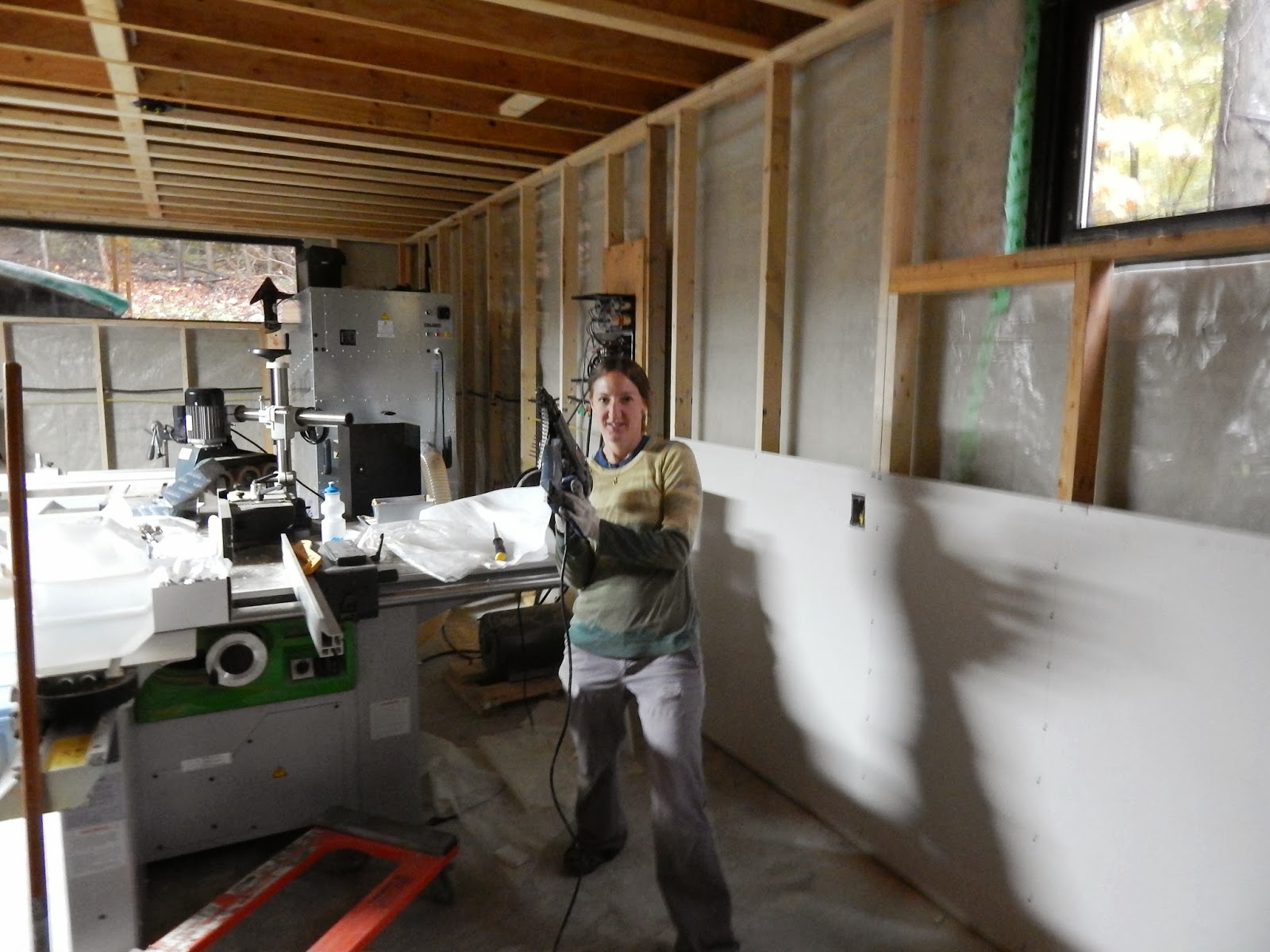
The sheetrocking begins

Er takes on the screw gun - watch out!


We then put up the sheetrock upstairs....


Gaps were left at the top of the sheetrock to insert the hose for the insulation (see next post!)


Then Rob Became a Plumber

We bought a device called a Manablock that serves as the central device for the hot and cold water for the plumbing system. This device also functions to prevent a pressure drop when more than one faucet is used at a time.
 

Rob installed the venting pipes (which you can see in the pictures) and the drain pipes (which are in the floor) to the dual flush toilet....


This is a hanging toilet frame with the tank hidden in the wall

To the future shower....


To the kitchen sink....


Rob then installed the tank for the water pump and the tankless hot water heater.

Historic moment - the first time Rob is reading a manual!

This is the tank for the water pump

Rob is connecting the hot water heater


**Note the Lifebreath HRV (heat recovery ventilator) in the middle


We were now ready to turn on the water...

Amazingly, on the first try....it worked!


We have water!

Are you sure Rob is a carpenter??


Thursday, January 2, 2014

We Became Electricians....

There is quite a story behind how we ended up learning how to put in the electric system in our house...and doing it ourselves! You can read on an earlier post how our experience with our first electrician ended in disaster. We had a second electrician, Frank Mele, who helped us wire Rob's machines in his workshop. Frank was supposed to do the rough electric for us as well in a labor swap with Rob; however, after making plans with Frank, when the time came to do the work, Frank was nowhere to be found. After contacting him for over a month, we were desperate.** We "interviewed" several electricians for the job - most didn't call us back and we ended up with two quotes, which were way too high. Our last resort was to figure out how to do the electric ourselves. We had a kind offer from the electric inspector to go through what needed to be done, but the inspector ended up canceling two appointments at the last minute...ultimate frustration.

Enter Su. Su was apparently sent to us from God (according to her), which we really appreciate. She was a friend of a neighbor and came to volunteer just in time. Through her Church connections, Su was able to find us Electric Ed. Electric Ed was a former electrical inspector who was willing to give us lessons on how to install the electric system. Over the course of three lessons, Ed helped us to design the circuits, taught us about "daisy chains" and "pigtails" and Amps and Volts, explained what color wire we needed for which circuit, and we set to work. 

**As an aside, we knew Frank was around because he was doing work for our neighbor Justin. Frank, we hate you!

Step 1: Running the wire

The first step was understanding that outlets generally need 12 gauge wire (yellow 12-2 wire) that can handle up to 20 Amps and up to 12 outlets. According to code, there needed to be an outlet every 6 feet. These can be daisy chained together. The recessed lighting that we planned to put in needed 14 gauge wire (white 14-2 wire) that can handle up to 15 Amps. These could also be daisy chained. We had special airtight outlet and light boxes that Rob installed, and we ran the wire. We were instructed to leave the wire hanging out about 6 inches from each box, so that's what we did.

A special team arrived to help with the job


Step 2: Pigtails and Ground Wire

After step one, we next had to strip the end of the wire. When you strip a 12-2 or 14-2 wire, you find three wires inside -  the "hot" (black), the ground (copper), and the neutral (white). Our task was to join the like color wires in each box with a wire nut (red or yellow winged structure) - the ends of these are stripped and cut to fit into the wire nut. A separate strip of the same color is then added coming out of the nut - this is the "pigtail" that will be attached to the electrical device. The "hot" wire brings electricity to the device, while the "neutral" wire closes the loop to the breaker box; the ground wire is there in case anything goes wrong and the system needs to be grounded. At this stage, the ground wire was left hanging out in the center.


Next, the ground wires were twisted together and connected with a crimp sleeve, or what Electric Ed calls a barrel clamp. One end of the ground wire is left unattached to be connected with the electrical device.


Step 3: Installing the breakers

At the other end, all the wires came to the breaker box. We had to figure out what type of breaker we needed for each circuit in our house. We learned about GFI breakers for circuits that go through wet areas, a new type of breaker called an ARC breaker that is needed for living spaces, and generally that outlets and devices that will be using 110 V need a single pole breaker, while devices using 220 V need a double pole breaker, and finally that we needed tandem breakers so that everything would fit (because things like our hot water heater needed 3 double pole 40 Amp breakers).


Rob repeatedly zapped himself because he wanted to listen to the radio, so didn't turn off the main breaker

Rob's common line as he zapped himself was "It's only 110 Volts"


Step 4: The Rough Inspection

We passed!


This means we now had the okay to install outlets, lights, devices, etc....ongelovelijk.